Virtual Connector Assembly: Simulating Electronic Connector Assembly
In the electronics and automotive industries, connectors are critical components. A small error in dimensions, deformations, or tolerances can lead to assembly failures, electrical issues, or costly reworks.
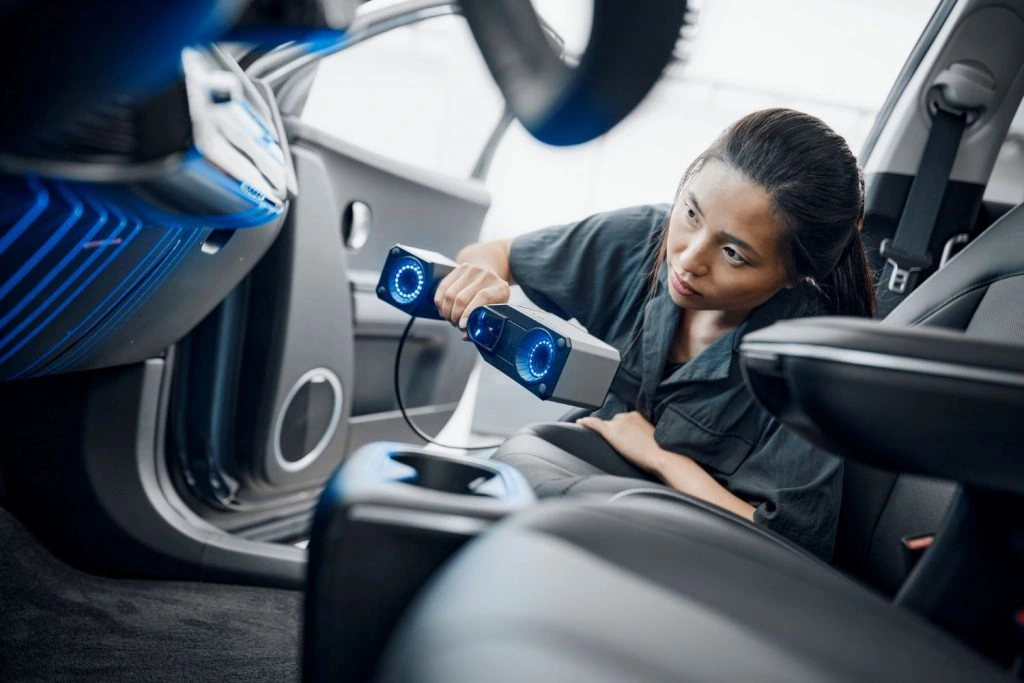
Today, leading companies utilize virtual assembly through 3D scanning to validate components before they reach production. ZEISS HandsOn Metrology solutions allow for the digitization of physical parts to simulate their interaction in a virtual environment using ZEISS Inspect.
What is Virtual Assembly?
Virtual assembly is a process in which multiple 3D-scanned components are digitally combined to analyze how they interact with each other. This allows for:
- Detecting interferences
- Analyzing tolerances
- Verifying alignment
- Validating assembly functionality
- Preventing production failures
In industries where margins of error are minimal, this technology is becoming a standard.
Common Issues in Electronic Connectors
Connectors must assemble perfectly to ensure signal transmission and mechanical strength. Frequent issues include:
- Misalignment: Small deviations prevent correct assembly.
- Interferences: Components that collide with each other during assembly.
- Plastic Deformation: Materials may change shape after molding or cooling.
- Dimensional Variation: Differences between the CAD design and the actual part.
Detecting these issues before production can save thousands of dollars.
Limitations of Traditional Inspection
Many companies still rely on methods such as physical assembly tests, calipers, tactile CMMs, or visual inspection. These methods present several disadvantages: they are time-consuming, do not show the complete assembly behavior, can damage delicate parts, and do not allow for advanced digital analysis.
How Virtual Assembly Works with 3D Scanning
- Component Scanning: Systems like the ZEISS T-SCAN hawk 2 or ZEISS ATOS Q capture the actual geometry of the parts.
- Creation of Digital Models: High-resolution 3D meshes are generated.
- Software Import: Data is analyzed within ZEISS Inspect.
- Assembly Simulation: Parts are digitally positioned according to the CAD design.
- Interference Analysis: The software detects collisions, clearances, or deviations.
Advantages of Virtual Assembly
- Reduction in reworks
- Fewer physical prototypes
- Faster production startups
- Improved communication with suppliers
- Data-driven engineering decisions
Industry Applications
Virtual assembly is especially useful for automotive connectors, electrical harnesses, electronic components, medical devices, and complex plastic assemblies. Many companies use this technology during APQP and design validation.
Electronics Manufacturing Growth in Mexico
Mexico is a leading electronics manufacturing hub in the Americas. Regions such as Guadalajara, Querétaro, Tijuana, and Ciudad Juárez concentrate much of the production for connectors and harnesses, driving the adoption of advanced inspection technologies.
How 3D Metrisoft Helps Implement Virtual Assembly
At 3D Metrisoft, we help companies in Mexico implement 3D metrology solutions with ZEISS technology. We provide support through on-site demonstrations, part digitization, ZEISS Inspect training, and quality process integration.
Frequently Asked Questions
Does virtual assembly replace physical testing?
Not always, but it significantly reduces the number of physical prototypes required.
What is the accuracy of 3D scanning?
Industrial systems can reach accuracies down to microns depending on the specific application.
Can multiple configurations be analyzed?
Yes. The software allows you to test different scenarios quickly.